
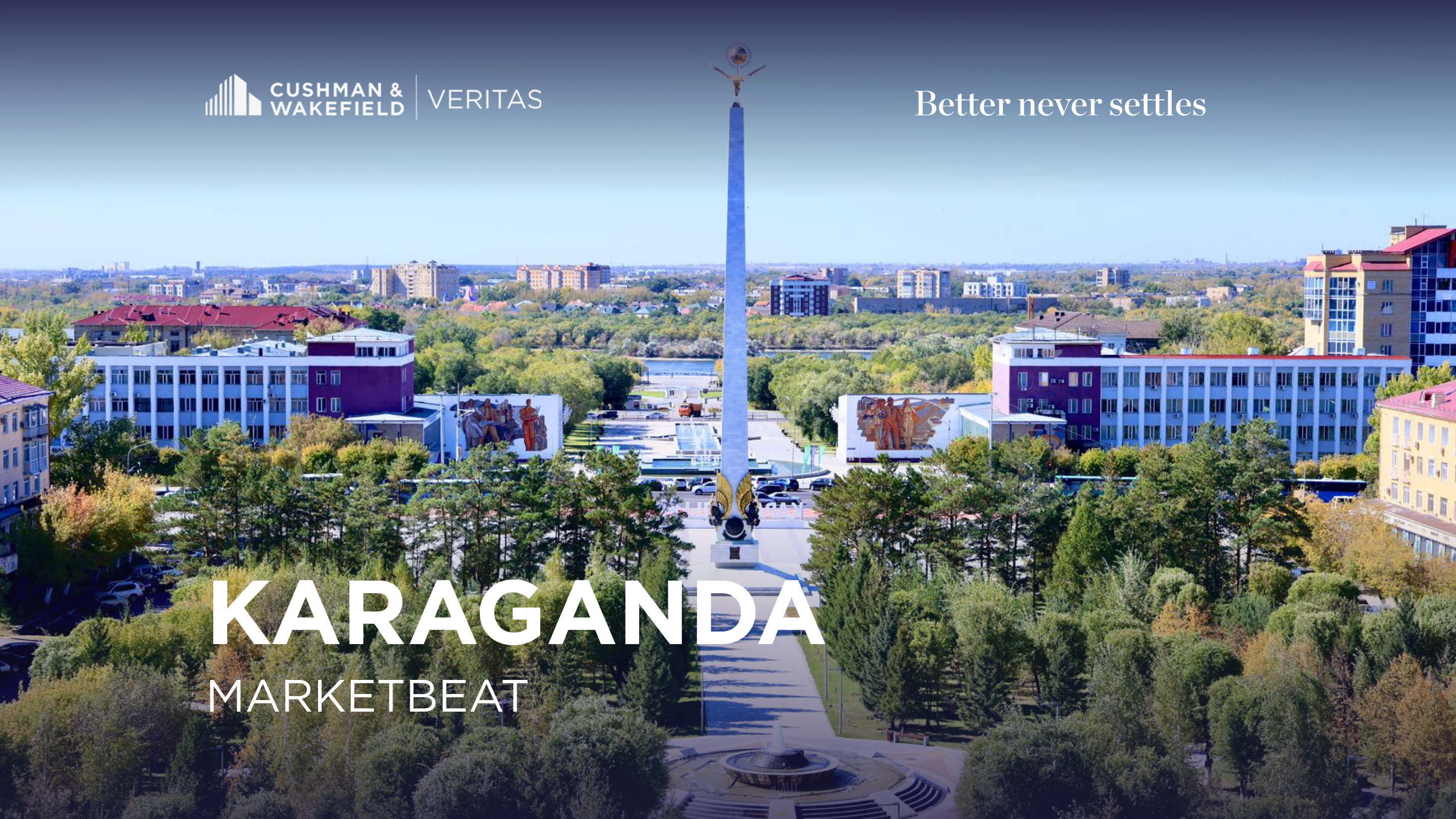
KARAGANDA MARKETBEAT
Karaganda Market Beat 2026: A Regional City Entering a New Investment Cycle
Karaganda has long been recognized as one of Kazakhstan’s most important industrial cities, historically shaped by mining, metallurgy, and large-scale manufacturing. Yet in recent years, the city has been quietly shifting into a new phase of development—one defined not only by its industrial legacy, but by gradual modernization, strengthening business activity, and a growing demand for higher-quality real estate.
The Karaganda Market Beat 2026 report explores this transformation in detail, providing a structured overview of the city’s economic environment and the performance of its key real estate sectors.
Economic Position: A City Built on Industry, Supported by Regional Stability
Karaganda remains one of the most strategically important regional cities in Kazakhstan. Its central location gives it a logistical advantage, connecting key transport routes and making it naturally positioned as a distribution and industrial support hub for surrounding regions. The city continues to play a strong role in Kazakhstan’s industrial chain, supported by large enterprises and an established labor base.
At the same time, Karaganda is gradually expanding its service economy. Retail, construction, and small business activity have become increasingly noticeable components of local economic growth. This diversification is important: it strengthens resilience and creates demand for real estate beyond traditional industrial functions.
As Kazakhstan continues to focus on regional development, cities like Karaganda are becoming more relevant to investors seeking stable fundamentals, manageable entry costs, and long-term demand drivers.
Demographics and Urban Structure: Mature Demand with Changing Expectations
Unlike fast-growing cities driven by migration and population expansion, Karaganda represents a more mature demographic model. Demand here is less about volume growth and more about qualitative change – residents increasingly seek better housing formats, improved urban infrastructure, and modern retail and service environments.
This shift is visible across multiple segments. While older districts still dominate the city’s built environment, new development projects are gradually shaping updated residential clusters and modern commercial spaces. The city’s structure continues to evolve from Soviet-era planning into a more mixed-use model, where residential and commercial functions increasingly intersect.
For more details and full market analytics, see the complete Karaganda Market Beat 2026 report.
Related Research & Insights

STUDENT ACCOMMODATIONS IN ALMATY
